
Texas Registry Is Not Custody
The Texas Department of Public Safety compiles public registration data received from local authorities. The registry is listed in the Mason Facility Map because it can be a post-custody status path for a qualifying person, but it is not a detention site. It has no release door, inmate population, booking roster, or general release archive.
A matching public entry can show that a person is registered in the community under Chapter 62 of the Texas Code of Criminal Procedure. It does not prove the person was booked in Mason County, released by Mason County, or discharged from a sentence. People without a legal registration duty will not appear, so the registry cannot answer a broad released-inmate search.
Search Mason Registry Records
Start with the official Texas DPS Public Sex Offender Registry. Enter the known person or location data allowed by the interface. Open a candidate record only after matching the name, age or birth information, reporting authority, offense details, and other public identifiers.
- Use exact identifying data rather than browsing by a common name alone.
- Compare the result's identity fields and registering authority.
- Read the offense and registration data within the record's stated scope.
- Do not treat the photograph as the Mason County booking photo without a separate official link.
- Use sheriff, court, TDCJ, BOP, or ICE records to verify the actual custody and release event.
The registry result may remain useful after a temporary jail roster no longer shows a person. Its durability does not turn it into proof of why or when custody ended.
Texas Registry Result Fields
Chapter 62 requires qualifying registrants to provide specified information to the local registration authority. DPS compiles public data supplied by those agencies. Fields can help resolve identity, but each has a limit.
| Registry field | What it can establish |
|---|---|
| Name and aliases | Identifies the public registrant, subject to careful matching. |
| Physical descriptors | Helps distinguish people who share a name. |
| Color photograph | Shows the registry image, not necessarily a booking photograph. |
| Registration authority | Identifies the local agency responsible for the public entry. |
| Reportable offense data | Describes the qualifying basis shown by the registry. |
| Address or location data | Shows public registration information subject to registry rules and updates. |
None of these fields supplies the actual Mason jail release timestamp, release type, receiving agency, or court disposition. Those facts come from the corresponding custodian.
Texas Registry Source View
The official DPS registry search is documented in the successful manifest image below.
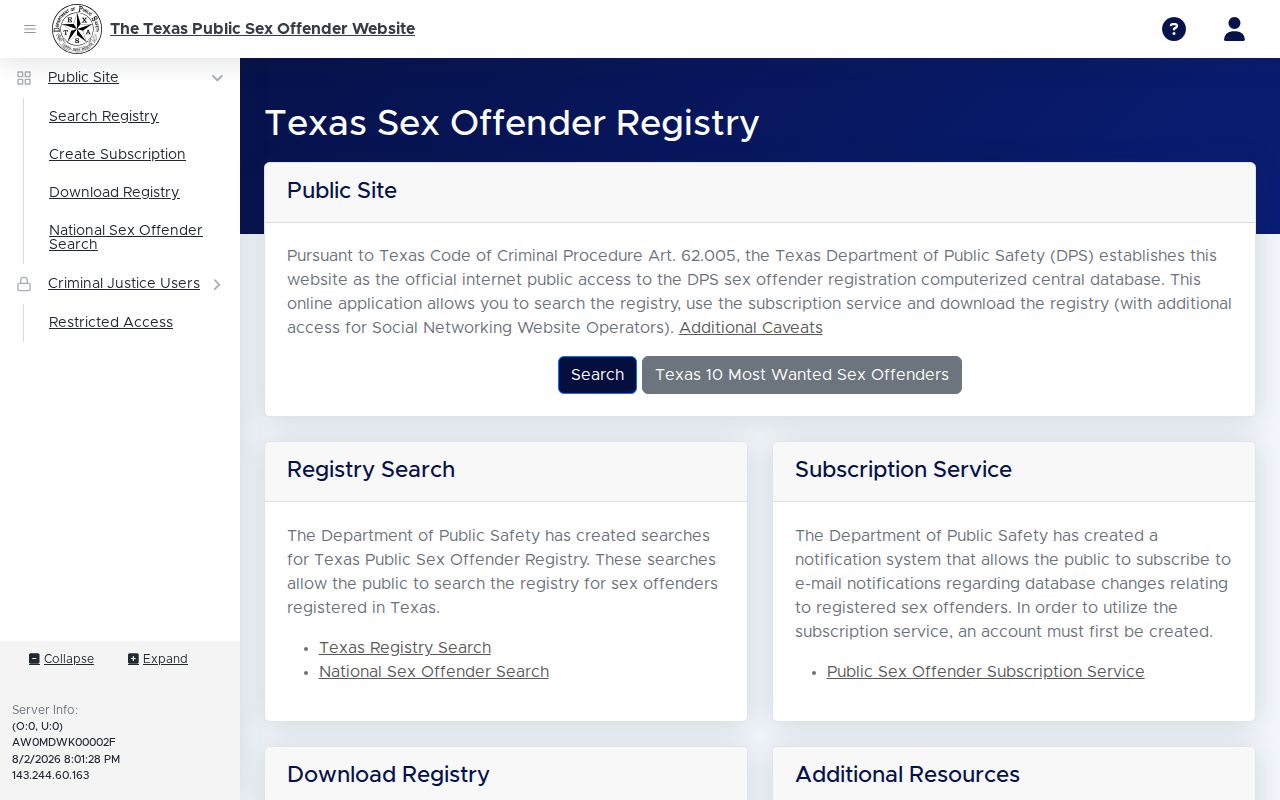
The search is statewide and limited to qualifying registrants. It should be labeled as a registry lookup, not a recent-release roster or detention locator.
A screenshot of a result must not expose more personal data than needed. For verification, preserve the source URL, search date, and record identifiers rather than detaching the image from its official context.
Registry Photos Versus Mugshots
A Texas registry entry may include a color photograph. That image supports identification of the registrant within the registry. It is not automatically the booking photo taken during a Mason County arrest. The dates, agency, and purpose can differ.
For the local booking image, identify the Mason booking and request the public photograph from the sheriff or jail, subject to lawful redaction. If the person entered TDCJ, remember that the free TDCJ email-history service excludes photographs. A registry image cannot fill that gap or establish state-prison history.
- Registry image
- A photo maintained for the qualifying public registration record.
- Booking photo
- An intake image tied to a specific arrest and jail booking.
- Custody photo
- A broader term that must be labeled by the agency and event that created it.
- Release record
- The transaction showing when and how a custodian's control ended.
Registry Status After Release
Registration can continue in the community after jail or prison custody ends. That is why the registry may show a person who no longer appears in a current inmate locator. It does not mean the registry itself released or supervises the person. The local registration authority maintains duties defined by law, while parole or probation may involve separate agencies.
Parole is conditional release from state prison under TDCJ Parole Division. Probation, called community supervision in Texas, is ordered by a court and administered through a community supervision department. Registration is a distinct legal duty. A person can be subject to one, several, or none of those systems depending on the actual case.
Use the court judgment and supervision record to explain legal status. Use the registry only for its public registration fields.
Verify Mason Release Separately
When a registry result is found for someone connected with Mason County, return to the custody source. For a local booking, call the Mason County Sheriff with full name, birth date, booking date, and booking or cause number. Ask whether the person is physically present, the actual release date and type, and whether a receiving agency took custody.
If the case went to TDCJ, search by SID or TDCJ number and obtain incarceration history or the actual release record. For federal custody, use BOP. For immigration detention, use ICE ODLS. A registry result does not choose among those paths.
The Mason released-inmate record chain covers the local starting point and helps keep the registry entry from being used as substitute proof.
DPS Registry Program Contact
The public search and the DPS registration program page are the official statewide sources. The program page explains the DPS role and the statutory information flow from local authorities.
Texas DPS Public Registry
System: Statewide Public Sex Offender Registry
Operator: Texas Department of Public Safety
Custody role: None; this is not a jail or prison
Coverage: Qualifying people with a legal registration duty
Questions about a specific public entry should be directed through official DPS or listed registration-authority channels. Keep the record identifier and search date. Do not ask a detention facility to correct a registry field it does not control.
Registry Absence Proves Little
A no-hit may mean the person has no registration duty, the search data does not match, the record is not publicly displayed under the applicable rule, or the wrong person was searched. It does not prove that the person is in custody, released, acquitted, discharged, or free of every legal obligation.
Likewise, a matching result does not establish the date of a Mason release. It may reflect a registration update made after an unrelated custody episode. Compare the registry authority and update information with the sheriff transaction, TDCJ history, or court judgment before describing the sequence.
Note: The Texas registry is a post-custody corroboration source for qualifying registrants, never a universal released-person list.
Registration and Transfer Records
A person can leave Mason custody by transfer rather than community release. A later registry result does not erase that intermediate custody. The Mason movement entry should identify the receiving agency. Follow that agency's locator or records channel until an actual release is documented.
Historical reporting about Mason's small jail shows why transfer has long been a meaningful local possibility, but the dated report does not establish a current overflow destination or contract. Use it only as context. The current person-specific record must control.
Build the timeline from dated sources: Mason booking, local movement or release, state or federal custody, later release, and registration update. Do not collapse those events into one claim.
Correct a Registry Record
If a public registry field appears wrong, save the official record identifier and identify the precise disputed field. Gather the court order, registration document, release record, or other source that contradicts it. Ask DPS or the listed registration authority which office controls the correction or annotation.
Texas expunction and nondisclosure are separate legal processes with outcome-specific rules. Release from custody alone does not qualify a record for either. A custodian may also apply juvenile, victim, privacy, or other limits. Do not infer a right to remove a registry entry merely because a booking ended.