
TDCJ Releases Serving Mason
The Texas Department of Criminal Justice, Correctional Institutions Division is the statewide prison system. It is not the Mason County Jail, and no TDCJ unit was identified inside Mason County. A Mason jail departure to TDCJ is a transfer into state custody. The person has left the local booking but has not entered the community.
Once TDCJ receives a sentenced person, the statewide locator is the proper current-custody source. Later, parole or mandatory supervision can put the person outside prison under legal supervision. Full discharge is different. TDCJ defines the discharge date as completion of the sentence and release from incarceration, parole, mandatory supervision, or community supervision. The exact status determines where a person goes and which record confirms it.
Search TDCJ Mason Records
Start with the official TDCJ locator. Search by a current TDCJ number or SID when possible. A name search can use identifying details, but every result should be checked against county of conviction, cause number, offense, sentence date, and identifiers. This prevents a same-name match from becoming a false Mason release claim.
- Enter the TDCJ number or SID, or use a carefully matched name search.
- Confirm the conviction county, cause number, sentence, offense, and identity fields.
- Read Projected Release Date, Maximum Sentence Date, and Parole Eligibility Date as separate fields.
- If later processing shows Scheduled Release date and location, treat them as changeable operational fields.
- For actual release or discharge, obtain history and the dated release record rather than relying on a projection.
The current locator is principally for people still incarcerated. A no-hit does not prove release, discharge, or absence of a TDCJ history.
TDCJ Release Date Fields
TDCJ date labels have narrow meanings. Confusing them can turn eligibility or planning data into a false report of physical release. The actual release transaction remains the stronger record for the event.
| TDCJ field | What it means |
|---|---|
| Parole Eligibility Date | The earliest point for statutory review, not an order to release. |
| Projected Release Date | Classification and Records' current projection from incarceration if parole does not occur sooner. |
| Maximum Sentence Date | The calculated sentence endpoint under the governing record. |
| Scheduled Release date | A later operational date after certificate and audit work; it may change without notice. |
| Scheduled Release location | The planned release site, which can change with processing or a detainer. |
| Discharge Date | Completion of the sentence and linked incarceration or supervision. |
A favorable Board vote also is not the physical exit. Program conditions, release planning, a records audit, discipline, or a detainer may remain.
TDCJ History After Release
When a former state inmate no longer appears in the current locator, use the TDCJ email-information route. Put the person's name in the subject and include the full name with a seven-digit TDCJ number or exact birth date. If the birth date is unknown, TDCJ asks for approximate age and county of conviction.
The matched manifest image documents that official history channel.
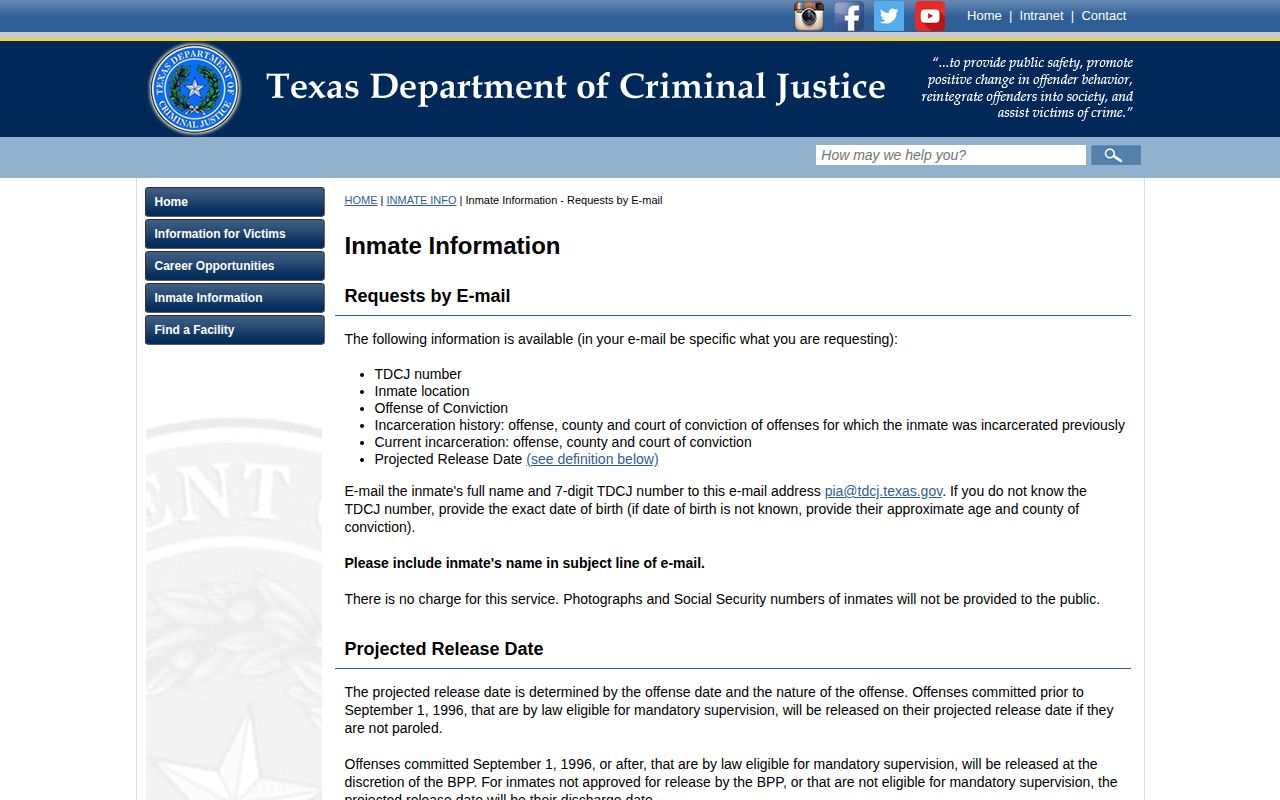
TDCJ says the no-charge response can include the TDCJ number, location, offense and county or court, incarceration history, current incarceration offense, and projected release date. It excludes photographs and Social Security numbers. Ask the Public Information Act unit for an actual release certificate, release date, status, or discharge record when history alone cannot settle the event.
TDCJ Release Definitions Matter
The official TDCJ definitions distinguish projected release, parole, releasee, and discharge. The successful manifest capture below supports those terms.
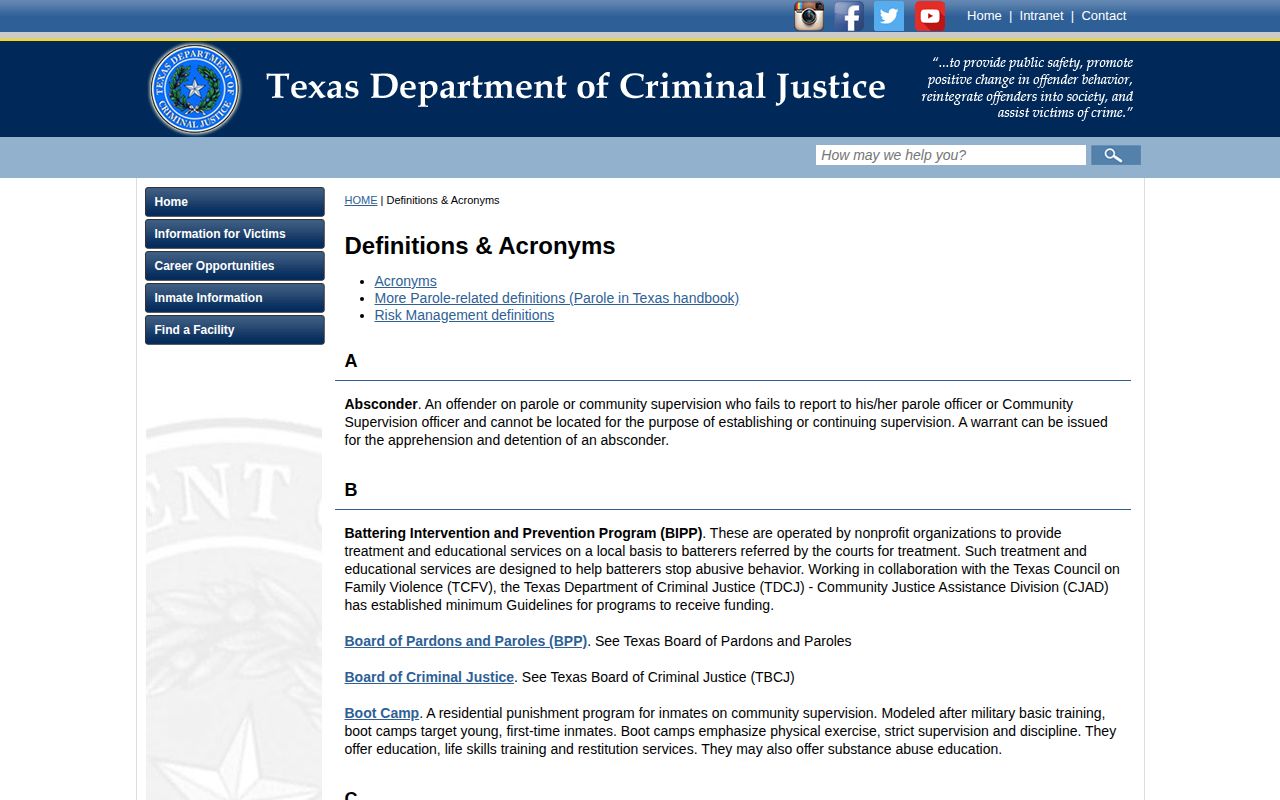
Parole is conditional release from prison to serve the rest of a sentence under supervision. Mandatory supervision is another supervised release path governed by offense, date, time credit, and Board rules. A releasee reports to a parole officer. Discharge means the sentence and supervision are complete. A person may therefore be physically out of prison for years before discharge.
- Parole
- Conditional prison release under TDCJ Parole Division supervision.
- Mandatory supervision
- A statutory supervised-release path subject to eligibility and, for many cases, discretionary Board review.
- Releasee
- A person outside prison who remains subject to parole supervision.
- Discharge
- The end of the sentence and associated custody or supervision.
TDCJ Records and Contact
General TDCJ status information is available on weekdays from 8:00 a.m. to 5:00 p.m. at 936-295-6371 or 800-535-0283. Without a TDCJ or SID number, exact birth date is required. Before a Board vote, parole-review status uses 844-512-0461. After a favorable vote, release-processing status uses 512-406-5202 with TDCJ number, SID, or birth date.
TDCJ Public Information Request
Mail: P.O. Box 4017, Huntsville, TX 77342
Hand delivery: 2 Financial Plaza, Suite 600, Huntsville, TX 77340
Email: PIA@tdcj.texas.gov
Online: TDCJ request form
Request public incarceration history, actual release date and type, release certificate, discharge date, and unit or release location. TDCJ warns that some inmate and parole information is confidential. Ask for public portions and accept lawful redaction.
TDCJ Release Notifications
Texas divides county and state notifications. Texas VINE serves county custody and court events. TDCJ Integrated Victim Services System covers state-prison custody, parole, and mandatory supervision. A Mason booking that transfers into TDCJ may require a new IVSS registration because the county VINE registration does not necessarily follow the person.
IVSS is available at the TDCJ victim-services portal and through 800-848-4284. TDCJ states that eligible users and concerned citizens may search status and register for confidential notices, including release. Delivery can include letter, email, text, combinations, and in some cases telephone. A notice should trigger verification, not replace the release certificate or actual dated record.
Mason Transfers Into TDCJ
A person sentenced from Mason County may leave the Mason County Jail for a TDCJ intake path. The Mason movement entry should identify the destination or receiving agency. That entry proves local custody ended, but it does not prove prison release. Use the TDCJ identifier and Mason cause number to connect the two custody episodes.
Historical Mason reporting illustrates why transfer deserves attention. A 2006 account described the county's then-small jail and overflow in another county. That report does not establish a current contract, capacity, or destination. It does show why disappearance from Mason custody cannot safely be called release to the community without the receiving-agency field.
The Mason released-inmate lookup provides the local record chain when the custody episode began at the county jail.
TDCJ Retention Is Not Search
Removal from a public search interface is not the same as destruction of the underlying record. TDCJ publishes a one-year post-discharge destruction rule for a narrow category of district parole office field-file material. It does not state that central offender history, Board records, court records, or every electronic release record disappears after one year.
For older Mason state-prison cases, ask the appropriate TDCJ unit for the specific history or release document. Keep the cause number, TDCJ number, SID, conviction county, and date range together. If the response cites an exception or says no responsive record exists, verify the request reached the proper custodian before drawing a broader conclusion.
TDCJ Release Processing
TDCJ Review and Release Processing checks a proposed release plan, county-of-residence rules, discipline, special conditions, and required programs before issuing a release certificate. Classification and Records then completes audit and calculation work. TDCJ materials state that after the certificate reaches that stage, the process may take roughly 14 to 21 business days before a scheduled date and location appear. Even those fields can change.
A detainer, revised court record, disciplinary event, program requirement, or release-plan issue can alter the path. When the date arrives, distinguish release from TDCJ incarceration from transfer to another custodian. Seek the actual dated release record and receiving authority. A projected date, eligibility date, favorable vote, or scheduled date alone does not prove that the person walked out or entered the community.